
Bitcoin Split. Here Is What Happened and What It Means.

On August 8th, 2026, the Bitcoin blockchain split into two chains. Here is what happened, what each chain represents, and what it means for the future of Bitcoin.
A Split in the Blockchain
On August 8th, 2026, Bitcoin split. What began as a contentious soft fork attempt ended with two separate chains running different rules, different mining algorithms, and a fundamentally different vision of what Bitcoin is for. The event was over in hours for most of the network, but its implications are still unfolding. Most people checking their phones that Sunday morning had no idea any of it had happened but make no mistake, something historic did.
For the purposes of understanding what happened and where things stand today, we are going to frame this as what it actually is: a split in the Bitcoin blockchain that produced two distinct chains. Bitcoin SHA-256 is the original chain, running the same proof of work algorithm it has used since 2009. Bitcoin Blake2b is the chain that emerged from the BIP-110 movement, running a new mining algorithm and a new set of consensus rules.
Both chains trace their history back to the same genesis block. Both communities believe they are carrying Bitcoin's original values forward. The disagreement is about what those values actually mean in practice and that disagreement is worth understanding carefully before drawing any conclusions.
Let's break down what happened, what each chain represents, and what this split means for the future of Bitcoin.
The Events Leading Up to the Split
The story actually starts months before August 8th. BIP-110 had been circulating since December 2025, pitched as a temporary one year restriction on non-financial data being embedded in Bitcoin transactions. Ordinals, inscriptions, BRC-20 tokens, the protocols that had been exploiting Bitcoin's block space for data storage since 2022, were the target. Supporters believed Bitcoin's block space should be reserved for sound money transactions. Critics believed the protocol should remain neutral and that miners and users had the right to use block space however they chose, as long as they paid the fees.
The proposal required 55 percent of miners to signal support. Months passed. Miner support never cracked 3 percent. The five largest mining pools — Foundry, AntPool, F2Pool, ViaBTC, and MARA Pool — either stayed silent or outright refused. When the mandatory signaling window opened at block 961,632 on August 8th, the math was already closed. BIP-110 was not going to activate through miner support. What happened next would change Bitcoin forever.
The Split, Block by Block
Shortly after 4 p.m. on Saturday August 8th, two competing versions of the same block appeared at the same height on the Bitcoin network. The split had begun.
AntPool mined block 961,632 on the main chain without signaling BIP-110 support. The rest of the network accepted it without hesitation and kept building. For them, nothing unusual had happened.
BIP-110 nodes saw it differently. AntPool's block had not set the required signal. They rejected it.
At almost the same moment, a small mining outfit called Roughnecks, operating through Ocean Pool, produced a competing version of block 961,632 that did signal BIP-110 support. BIP-110 nodes accepted it. The chain split.
The legacy chain moved on immediately. Block 961,633 went to F2Pool. Block 961,634 landed with Simple Mining, an Ocean connected pool, meaning even within Ocean's own ecosystem the hashrate was divided. The legacy chain was already pulling away.
On the BIP-110 chain, Roughnecks ground out one more block at height 961,633 about an hour and a half after the split. Then nothing. No third block ever came.
The problem was mechanical. The BIP-110 chain inherited Bitcoin's full mining difficulty, calibrated for the entire network's hashrate, while attracting only a tiny fraction of it. The chain froze. The legacy chain kept stacking blocks every ten minutes as if nothing had happened.
By Sunday morning the legacy chain was more than 100 blocks ahead. Roughnecks announced they were done.
Why the UASF Played Out the Way It Did
To understand what happened, it helps to understand the three ways a Bitcoin protocol change can move or fail to move.
A MASF, or Miner Activated Soft Fork, is the traditional path. Miners signal readiness by marking the blocks they produce. Once enough blocks signal support within a set window, the upgrade locks in and activates. This is how Taproot activated in 2021, smoothly, with overwhelming miner support and no drama.
A UASF, or User Activated Soft Fork, takes a different approach. Node operators choose to enforce new rules without waiting for miners to signal approval. The idea is that nodes hold enough collective power to push a change through by simply refusing to accept blocks that don't comply with the new rules.
A URSF, or User Resisted Soft Fork, is the counter to a UASF. It is a coordinated movement of node operators running software specifically designed to reject and resist a proposed change, essentially organizing the opposition into an active force rather than passive indifference.
BIP-110 was structured as a UASF, and it had meaningful node support behind it. Roughly 20 percent of the Bitcoin network's nodes were signaling for BIP-110, a significant portion of the infrastructure that validates and relays transactions every day. Critically, there was no opposing URSF pushing back. No coordinated counter-movement of node operators ran software specifically designed to resist BIP-110. This was not two organized factions clashing. It was a meaningful minority of the network enforcing new rules while the miners chose to do something far simpler — nothing.
The miners didn't fight BIP-110. They didn't organize against it, debate it publicly, or negotiate around it. They simply ignored it. They kept producing blocks under the original rules as if the mandatory window had never opened. And because miners provide the proof of work that keeps a chain alive and moving, their indifference was decisive. Without blocks being produced, the BIP-110 chain had no heartbeat.
This points to something important. Miners don't control Bitcoin's protocol — nodes set and enforce the rules — but a chain with no miners is a chain with no confirmations, no activity, and no future. Node operators can enforce whatever rules they choose. But if the people producing blocks don't participate, those rules govern an empty ledger.
To understand why the miners' silence was so decisive, look at who the miners actually are. The chart above tells the story clearly. In any given week, the Bitcoin network's 1,042 blocks are divided among just 17 pools — and the top five dominate the picture. Foundry USA, AntPool, F2Pool, ViaBTC, and MARA Pool round out the top tier. Together these five pools routinely account for the overwhelming majority of all blocks mined on the Bitcoin network.
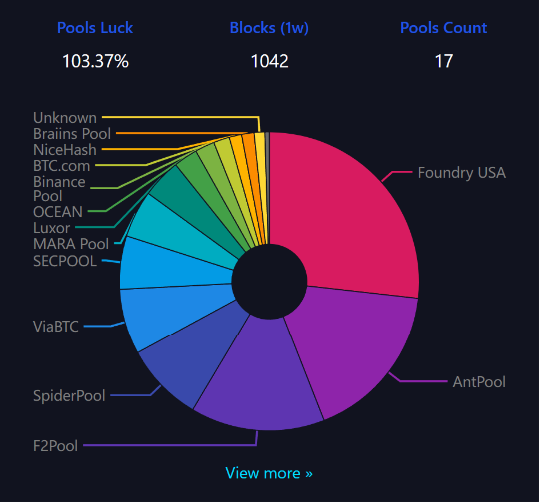
This is not how Satoshi envisioned mining. The original vision was a distributed network of individual miners, anyone with a computer contributing hashrate, no single participant holding outsized influence. What exists today is something very different. A handful of corporations, many backed by institutional capital, collectively control the machine that produces every Bitcoin block. They decide which transactions get included. They decide which proposals to signal for. They decide, by action or inaction, what happens to the network.
That concentration of power carries real risks. A coordinated group of large pools could theoretically delay or block any protocol change indefinitely simply by refusing to signal. They could, under certain conditions, attempt to reorg the chain, reverse transactions, or censor specific addresses. The economic incentives that discourage this behavior are real and significant, attacking the network destroys the value of the very asset miners are paid in. But incentives are not guarantees. And a Bitcoin whose security depends on the goodwill of five corporations is a Bitcoin carrying a risk its design was meant to eliminate.
This points to something important. Miners don't control Bitcoin's protocol. Nodes set and enforce the rules but a chain with no miners is a chain with no confirmations, no activity, and no future. Node operators can enforce whatever rules they choose. But if the people producing blocks don't participate, those rules govern an empty ledger.
The BIP-110 debate did not create the problem. It simply made it impossible to ignore. That is exactly what happened on August 8th. Twenty percent of nodes said yes. The miners said nothing. And nothing won.
The Birth of Bitcoin Blake2b
When the BIP-110 chain froze after two blocks, a small and determined group of developers kept working. Over the following three weeks they ground out a handful of additional blocks under Bitcoin's crushing SHA-256 difficulty, each one taking days to find. The chain barely moved but it stayed alive.
Behind the scenes, Luke Dashjr and developer Chris Guida finalized a plan to escape SHA-256 entirely. On August 29th, Dashjr called on miners to power down ahead of a dress rehearsal the following day. The test ran successfully. At block 961,640, a mining entity called Silent Wave produced the first block under the new Blake2b consensus rules. The chain came back to life. The final software release, Bitcoin Knots 29.4.1, shipped on September 2nd. By then the chain had mined over 800 blocks and its first difficulty retarget had already reduced the mining difficulty by 41 percent, making the chain accessible to ordinary hardware.
The BIP-110 community launched btc-blake2b.org and framed the chain not as a fork away from Bitcoin but as a continuation of it, a chain committed to Bitcoin's original purpose as sound, permissionless money, free from the data storage that they believe has corrupted the block space on Bitcoin SHA-256.
Both chains are now claiming to be the real Bitcoin. Both trace their lineage to the same genesis block. Both invoke Satoshi's white paper. The disagreement is about what Bitcoin was always meant to be and that question does not have an easy answer.
The Two Chains: What Each One Represents
Out of the events of August 8th, two distinct chains now exist. Understanding what each one stands for is more useful than picking a winner.
Bitcoin SHA-256 is the original chain. It runs the same SHA-256d proof of work algorithm Satoshi used in 2009. It is secured by an enormous amount of accumulated hashrate, the network recently crossed 1 Zetahash of total proof of work, and it is recognized by every major exchange, wallet, custodian, and institution in the world. It has not changed its rules. It continues producing blocks every ten minutes. Its community broadly believes that Bitcoin's neutrality, its willingness to process any valid transaction regardless of content is one of its core strengths, and that changing the protocol to exclude certain types of data sets a dangerous precedent for future censorship.
Bitcoin Blake2b is the chain that emerged from the BIP-110 movement after the soft fork failed. It replaced SHA-256d with the Blake2b hashing algorithm. It reduced the maximum block size to 300 KB, well below Bitcoin's existing limits. Its community believes that Bitcoin's block space is being exploited by non-financial data that burdens node operators, drives up fees for ordinary users, and undermines Bitcoin's purpose as sound money. By switching to Blake2b, the chain also breaks free from the large ASIC dominated mining pools that blocked BIP-110.
Both chains are now live. Both are producing blocks. Both communities are building. Where they go from here depends on the one thing neither side fully controls, the economic choices of the people who use Bitcoin every day.
What Bitcoin Governance Tells Us
This split exposed something worth sitting with regardless of which chain you find more compelling.
Bitcoin has no CEO. No board. No regulator. Changes to the protocol happen or don't happen through a messy, decentralized process involving developers, miners, node operators, and users. That process is slow and conservative by design. It requires genuine consensus, not just enthusiasm.
BIP-110 had a legitimate concern at its core. Non-financial data competing for block space is a real issue that the Bitcoin community will continue wrestling with.
The result was a split rather than an upgrade. Whether that split ultimately strengthens or weakens the Bitcoin ecosystem is a question only time can answer.
Our Take
At Hodl & Hash, we believe Bitcoin is money. Not a data storage network. Not a platform for pictures, tokens, and digital artifacts. Money. The kind that is hard to produce, impossible to counterfeit, and free from the control of any government or institution. That is what the white paper described and that is what we are here to protect.
The concern that drove BIP-110 is one we take seriously. Ordinals, inscriptions, and BRC-20 tokens are not harmless. They compete directly with financial transactions for block space, driving up fees for ordinary users who simply want to send and receive Bitcoin. They bloat the blockchain, making it harder and more expensive for individuals to run their own full nodes. And a Bitcoin network where running a node requires increasingly powerful hardware and storage is a Bitcoin network that is quietly centralizing — pushing validation into the hands of data centers and away from the sovereign individual running a node at home.
There is a deeper concern too. These mechanisms open up attack vectors on the network that did not exist before. Large, well-capitalized players embedding data in transactions at scale are not neutral participants. They are reshaping the economics of the block space in ways that favor those with resources over those without. The same centralization pressure we see in mining — a handful of pools controlling the majority of hashrate — can emerge at the transaction layer when block space becomes dominated by non-financial actors with deep pockets.
Bitcoin was designed to be antifragile. Every node that goes offline, every individual priced out of running their own validation, every mechanism that concentrates power in fewer hands moves the network away from that design and toward something more fragile and more controllable.
With that said, Bitcoin's resistance to contested protocol changes is itself a property worth defending. A Bitcoin that can be redirected by a sufficiently motivated minority — regardless of how noble the motivation — is a Bitcoin that can be redirected by anyone. The process matters as much as the outcome.
So where does that leave us?
Bitcoin SHA-256 carries the economic weight. The infrastructure, the exchanges, the institutional capital, and the accumulated security of 1 Zetahash of proof of work all sit on the original chain. That is not a small thing.
Bitcoin Blake2b carries something different — the philosophical essence of what Bitcoin was always meant to be. A chain committed to sound money, accessible mining, and block space reserved for financial transactions. Whether that vision can attract the economic gravity it needs to survive is the question that will define the next chapter of this story.
For those holding Bitcoin in cold storage, here is something worth knowing: because the chain split at block 961,632, anyone holding Bitcoin at that point holds the same amount on both chains. Your cold storage keys are valid on Bitcoin SHA-256 and Bitcoin Blake2b in equal measure. You started with both the moment the chains diverged.
At Hodl & Hash we will be holding both and watching both chains closely. This story is far from over.
What is certain is that the questions this split raised are not going away. Who controls Bitcoin? What is block space for? How much power should five mining pools have over a network designed to have no center of power? These are conversations the Bitcoin community will be having for years.
That is not a sign of weakness. That is what a living, decentralized monetary network looks like when it is working exactly as designed.
Start your Bitcoin education for free at Hodl & Hash and get a week's free access to the membership portal.
Ready to go deeper? Hodl & Hash membership unlocks trading education, market analysis, and our private community.